
Cabinet Staining
Cabinet Restoration services
Rich, Even Tone. Factory-Smooth Finish. Built for Daily Use.
At The Painters, cabinet staining in Ames and across Story County is treated as fine finish work, not general painting. Cabinets sit at eye level, catch direct light from windows and under-cabinet fixtures, and get touched hundreds of times a week. There is nowhere for a shortcut to hide.
Staining is also the least forgiving finish we apply. Paint sits on top of a surface and conceals what is underneath. Stain soaks in and reveals it. Every sanding scratch, every trace of old finish, every glue line and filler patch either disappears into the grain or announces itself permanently once the color goes down. That single difference is why cabinet staining separates experienced finishers from crews that simply own sprayers.
Iowa’s climate adds a second layer of difficulty. Kitchens in Ames swing from humid, cooking-heavy summers to bone-dry winter air running through forced-air heat. Solid wood doors expand and contract across that range, moving at the panel seams. A finish system that cannot flex with that movement will show hairline cracking at the stiles and rails within a few seasons.
While much of our cabinet work is centered in Ames neighborhoods such as Old Town, North Grand, Somerset, and the newer subdivisions in south Ames, we also stain cabinets throughout Story County in Nevada, Huxley, Gilbert, Slater, Cambridge, Roland, Story City, Colo, Zearing, Maxwell, and surrounding acreages. Rural properties frequently bring their own variables: hand-built or locally milled cabinetry, unconditioned porch and mudroom cabinets, well water with high mineral content that leaves residue on doors near the sink, and older finishes with no documentation of what was originally applied.
Our process accounts for all of it. We identify the wood species, test the existing finish, evaluate how the space is lit, and select a stain and topcoat system engineered for cabinetry — not general-purpose wood stain from a big-box shelf.
For professional cabinet staining throughout Ames and Story County, call +1 515-290-0421.
Why Trust The Painters for Cabinet Staining
Cabinet staining rewards patience and punishes speed. Our reputation has been built by controlling the variables most crews leave to chance: dust, moisture content, sanding sequence, stain penetration time, and cure conditions between coats.
The most common call we get is not from a homeowner starting fresh. It is from someone living with a cabinet job that went wrong. Blotchy maple that came out cloudy in patches. Oak that turned an unintended orange under warm kitchen lighting. Doors that felt tacky for weeks. A finish that peeled at the sink base within a year because the old topcoat was never properly deglossed.
Our crews are trained to read what a house is telling them. In older Ames homes and established Story County towns like Nevada, Roland, and Story City, we routinely encounter solid oak and birch cabinetry from the 1960s through the 1990s, often carrying a lacquer or conversion varnish that has ambered, thinned at the handle areas, and gone brittle at the edges. In newer construction across south Ames, Huxley, and Gilbert, the more common situation is builder-grade maple or a thermofoil and veneer combination where the door fronts and the boxes are not the same material at all — a distinction that changes the entire approach, because those two substrates will never take stain identically.
Property owners across the area work with us because we prioritize:
- Species-specific preparation, including conditioning on blotch-prone woods
- Honest assessment of what a given wood species can and cannot become
- Controlled, dust-managed spray application rather than brush-and-wipe shortcuts
- Full cure scheduling before doors are rehung and drawers are loaded
- Clear communication when the existing cabinetry is not a good candidate for staining
That last point matters more than most companies will admit. Not every cabinet can be stained. Laminate, thermofoil, and heavily damaged veneer will not accept stain, and telling a homeowner otherwise sells a job that fails. When staining is not the right answer, we say so and walk through the alternatives.
Commercial clients throughout Story County — including offices, churches, clinics, rental portfolios, student housing near campus, and HOA common areas — rely on us for cabinet and millwork staining scheduled around occupancy. We regularly complete break room, reception, and unit turnover work during evenings, weekends, and low-traffic windows.
A homeowner near Ada Hayden Heritage Park called us after a previous refinish left visible lap marks across every door face, most noticeable in late afternoon when low western light raked across the kitchen. The underlying issue was brush-and-wipe application on a wood that needed sprayed, sanded coats. We stripped the failed layer, conditioned the substrate, and rebuilt the finish in sprayed passes. The lap marks are gone, and light no longer exposes the application.
Trust is earned through the finishes people live with for years, not the ones that photograph well the week they are installed.
Cabinet Staining vs. Painting vs. Refacing vs. Replacement
Homeowners researching cabinet work often find these terms used interchangeably. They are not the same, and the right choice depends on the cabinetry you already have.
Cabinet staining (refinishing). The existing finish is removed or thoroughly prepared, new stain color is applied into the wood, and a protective clear topcoat seals it. The wood grain remains visible. This works only on real wood or high-quality wood veneer.
Cabinet painting. An opaque coating covers the surface completely, hiding grain and color. This works on wood, MDF, and some properly prepared laminates. It is the right call when the existing wood is mismatched, patched, or a species you do not want to see.
Refacing. New veneer or laminate is applied to the cabinet boxes and the doors and drawer fronts are replaced. The boxes stay, the visible surfaces change entirely. This is a carpentry service rather than a finishing one.
Replacement. Everything comes out. Appropriate when layout is changing, boxes are failing structurally, or water damage has compromised the cabinet frames.
Staining is typically the strongest value when your cabinet boxes are solid, the layout works, and the wood underneath is worth showing. It is typically the wrong choice when the cabinetry is thermofoil, when doors have significant veneer delamination, or when previous repairs have introduced filler that will never accept color evenly.
We give this assessment during the estimate, before any commitment.
Our Cabinet Staining Services in Ames & Story County
Every project is scoped as a complete finishing system rather than a color change. Our cabinet staining services include:
- Kitchen cabinet staining and full refinishing
- Bathroom vanity staining and moisture-zone finish upgrades
- Color change staining, including lightening and tone correction where the species allows
- Stain matching to existing millwork, flooring, or a newly added cabinet run
- Island and accent cabinetry finished in a contrasting tone
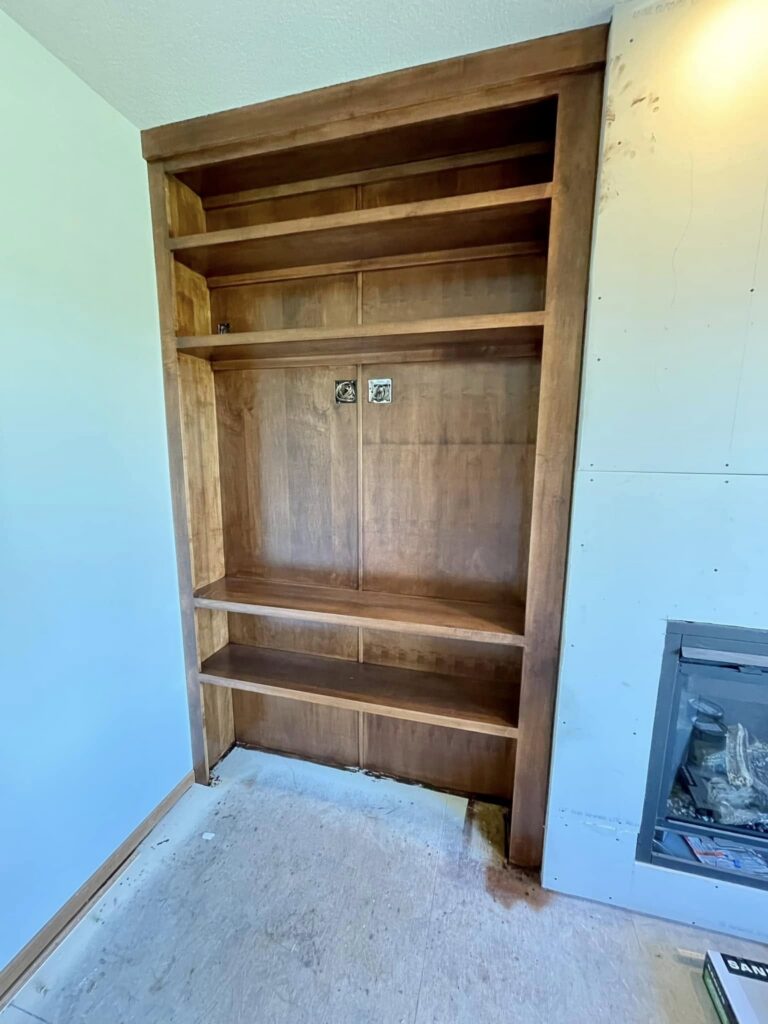
- Built-in bookcases, entertainment centers, mudroom lockers, and window seats
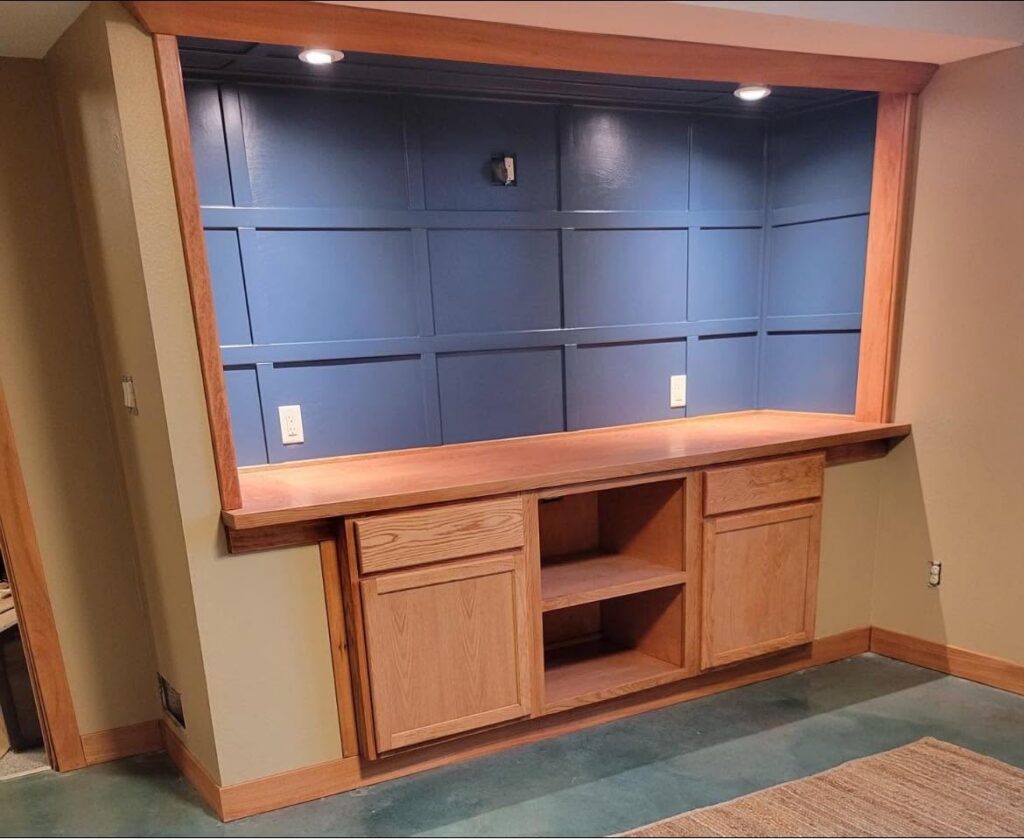
- Basement bar and laundry room cabinetry
- Interior door and trim staining coordinated to match cabinet tone
- Commercial casework, break room, reception, and restroom vanity staining
- Rental turnover cabinet refinishing across Story County
Each project begins with an on-site assessment. We identify the species, test the existing coating for compatibility, check for water damage at the sink base and dishwasher run, evaluate the lighting the finish will live under, and confirm whether the doors, drawer fronts, and boxes share the same material.
That last check is where many projects change direction. It is common to find solid wood doors paired with veneered or laminated boxes. Those surfaces take stain differently, and the plan has to account for it before a single door comes off the hinge.
Wood Species We Work With and How Each Takes Stain
Species is the single largest factor in what your finished cabinets will look like. Anyone who quotes cabinet staining without identifying the wood first is guessing.
Red oak. Extremely common in Ames homes built between roughly 1970 and 2000. Open, pronounced grain that accepts stain readily and evenly. Its natural pink and orange undertone is the reason so many homeowners want it changed, and it can be neutralized substantially with the right stain selection, though never entirely erased.
White oak. Tighter and straighter than red oak with a cooler base tone. Takes contemporary neutral and gray-leaning stains well.
Maple. Dense and closed-grain, which makes it the most blotch-prone common cabinet wood. Without a pre-stain conditioner or a gel or spray-applied stain, maple absorbs unevenly and produces cloudy patches. Maple also resists dramatic color change. Deep dark tones on maple usually require a toner or glaze layered into the finish rather than stain alone.
Birch. Behaves similarly to maple, prone to blotching, and often used for cabinet boxes paired with a different door species.
Hickory. Naturally high contrast between light and dark boards. Stain deepens that variation rather than evening it out. Homeowners who want uniformity are usually happier with a lighter tone on hickory.
Cherry. Rich, smooth, and continues to darken with age and light exposure. Blotch-prone and best served by conditioning and light stain application that lets the wood’s own color carry the result.
Alder and pine. Soft, absorbent, and highly blotch-prone. Conditioning is mandatory.
Wood veneer. Real wood in a thin layer over a substrate. It stains beautifully but sands away almost instantly. Veneer requires hand sanding with restraint, never aggressive machine work.
Thermofoil, laminate, and melamine. These are not wood and cannot be stained. Cabinet painting or door replacement are the honest options.
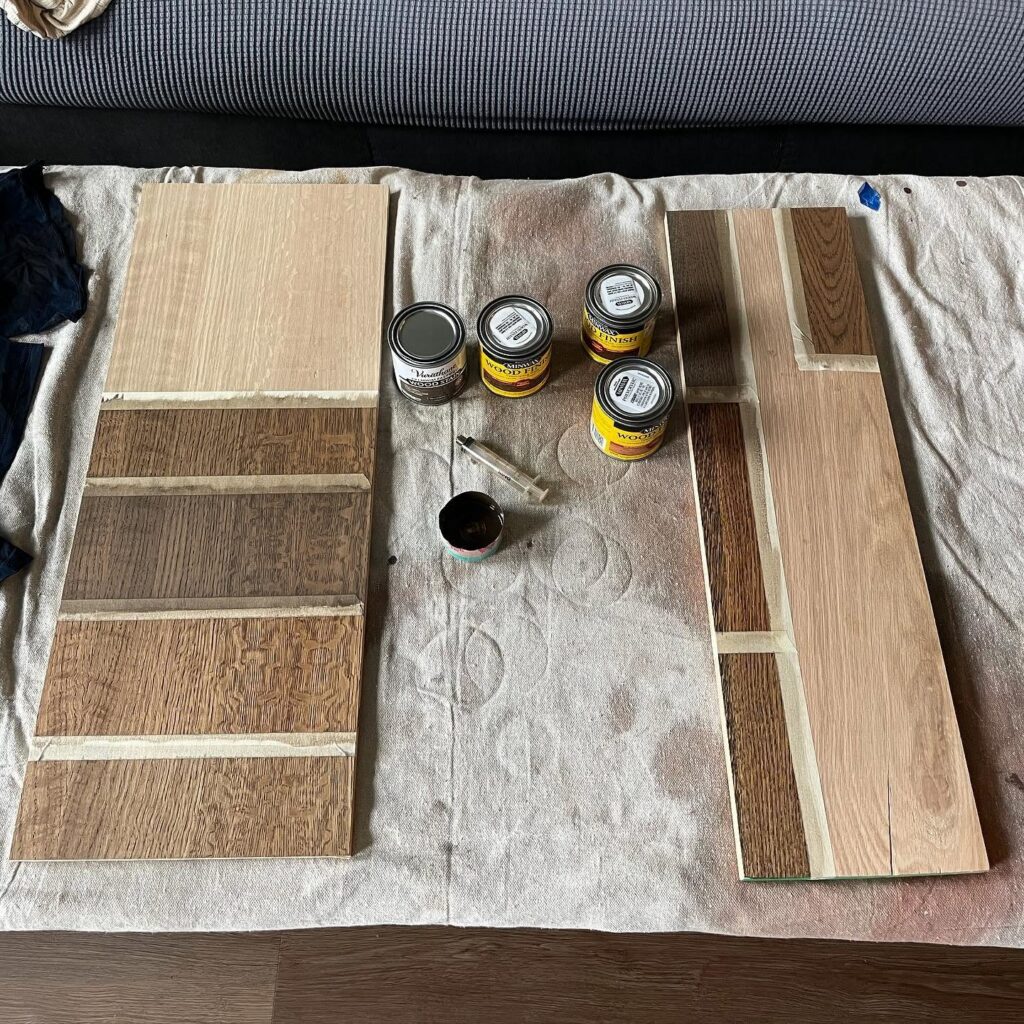
We confirm species during the estimate and set expectations then, using door samples where a color decision is close.
Preparation: Where Cabinet Staining Is Won or Lost
Preparation drives every outcome in staining. Because stain penetrates rather than covers, any contamination or scratch left behind becomes permanent once color is applied.
Documentation and disassembly. Every door, drawer front, hinge, and pull is labeled and mapped before removal. Cabinets are rarely perfectly square after decades of settling, and doors that go back to a different opening will not hang right.
Degreasing. Kitchen cabinets accumulate a film of airborne cooking oil, most heavily above the range and around the trash pull-out. That film blocks stain penetration and causes fisheye in the topcoat. We clean thoroughly with an appropriate degreaser and rinse before any abrasive work begins.
Existing finish removal. Depending on condition, we either strip the old coating chemically or sand it back mechanically. This is the most labor-intensive stage and the one most often shortchanged. Old finish left in the corners, in the profile of a raised panel, or along a bead detail will read as a light patch under new stain.
Sanding sequence. We work through progressive grits rather than jumping to fine paper. Skipping grits leaves deeper scratches that shallow sanding cannot remove, and those scratches darken visibly under stain. Sanding direction follows the grain without exception. On veneer, we hand sand and stop early.
Repairs. Loose joints are re-glued, split panels stabilized, and damaged edges addressed. We are direct about repair limits — wood filler does not accept stain the way surrounding wood does, and large filled areas will always be visible in a stained finish.
Dust removal. Between sanding and staining, surfaces are vacuumed and tacked. Dust trapped under a topcoat is a permanent texture defect.
Wood conditioning. On maple, birch, cherry, alder, and pine, we apply a pre-stain conditioner to regulate absorption and prevent blotching.
We set up controlled spray areas with containment and filtration, and doors are finished flat and horizontal so coatings level properly instead of sagging.
Stains, Topcoats, and Application Methods We Use
Product selection is based on the species, the existing substrate, and how the space is used. We routinely work with:
- Penetrating oil-based stains for depth of color and richness on open-grain species
- Water-based stains where faster recoat windows, lower odor, or occupied-home scheduling matter
- Gel stains for blotch-prone woods and for situations where limited penetration is an advantage
- Toners and glazes to adjust and correct tone on species that resist stain alone
- Catalyzed and post-catalyzed clear topcoats for kitchen-grade hardness and chemical resistance
- Waterborne polyurethane and acrylic topcoats where low odor and non-yellowing clarity are priorities
Sheen selection is a practical decision, not just a visual one. Satin and low-luster finishes hide fingerprints and minor surface variation and are what most Ames kitchens end up in. Semi-gloss cleans easily and reads more traditional but shows every smudge and imperfection under direct light. Matte reads modern and understated but is less forgiving of scrubbing.
Application. Cabinet doors and drawer fronts are sprayed, not brushed. Spray application is the only way to get a uniform, factory-smooth film with no brush texture or lap marks. Cabinet boxes and face frames that remain installed are finished in place with a combination of controlled spray and fine brush work in areas where spray is not practical.
Between coats, we scuff sand lightly to knock down raised grain and any settled dust, then re-tack before the next pass. This intermediate sanding is a large part of why a professional finish feels smooth to the hand rather than slightly gritty.
Cure conditions. This is where Iowa’s seasons matter. Cold air slows cure. Humid air slows cure and can cloud some finishes. Dry winter air raises static and attracts dust. We monitor conditions and schedule coats accordingly rather than working to an arbitrary clock.
There is a difference between dry to the touch and fully cured. A topcoat can feel dry within hours while its film continues hardening for days or weeks. Loading shelves or stacking dishes too early presses that soft film against contents and leaves permanent impressions. We tell you specifically when each stage is safe.
What to Expect When You Hire The Painters
Cabinet staining is more disruptive than wall painting and less disruptive than a remodel. Knowing the sequence in advance makes the process manageable.
Assessment and estimate. We evaluate species, existing finish, condition, and lighting, then provide a defined scope in writing. We discuss what your specific wood can realistically become.
Sampling. Where a color decision is close, we prepare samples on your actual cabinet material — not on a generic wood chip. Stain looks different on every species, and it looks different again under your kitchen’s lighting. We recommend viewing samples in both daylight and evening light before you commit.
Setup and containment. We protect countertops, flooring, appliances, and adjacent rooms, establish containment, and set up a spray area.
Disassembly and prep. Doors, drawer fronts, and hardware are removed, labeled, and prepped.
Staining and topcoating. Color is applied and inspected, then sealed under multiple topcoat passes with sanding between coats.
Cure, reassembly, and walkthrough. Doors are rehung, hardware reinstalled, alignment checked, and we walk the project with you in the lighting you actually live under.
Living in the space during the work. In most kitchen projects, the boxes are usable for part of the timeline while the doors are out being finished. We plan around a working sink and refrigerator access wherever possible and let you know in advance which days will be the most restricted.
If we uncover hidden issues — water damage at the sink base, veneer delamination, a substrate that will not hold a finish — we stop, show you, and review options before proceeding. Changes are never made to scope or cost without your approval.
To begin your cabinet staining project, contact us at +1 515-290-0421.
A Cabinet Staining Project Completed in Ames
In a home off Northwestern Avenue in north Ames, the homeowners had a 1990s red oak kitchen they described as reading orange under every light in the house. Two contractors had told them their only option was paint.
Our assessment found solid red oak doors and frames in sound condition with a worn factory finish, thinnest at the pulls and around the range. The boxes were oak veneer, intact, with no delamination.
We stripped and sanded to bare wood, hand working the raised panel profiles and the bead detail on the door edges where the old finish had built up heaviest. The pink and orange undertone was addressed with a cool-leaning stain and a light toning pass, which pulled the wood toward a neutral medium brown while keeping the oak grain fully visible. Doors and drawer fronts were sprayed flat, sanded between coats, and finished in a catalyzed satin topcoat. Boxes and face frames were finished in place.
The doors were off site for the finishing stage, and the homeowners kept sink and refrigerator access throughout. Hardware went back on after the topcoat had cured enough to handle, with a longer window recommended before shelves were reloaded.
At the follow-up, the homeowners reported the change they noticed most was not the color but the light — the kitchen no longer cast a warm tint onto the walls in the afternoon.
Caring for Stained Cabinets in Iowa Homes
A well-executed finish lasts years. How it is maintained determines whether that becomes a decade.
- Wipe spills promptly, particularly around the sink, dishwasher, and coffee station
- Clean with a soft cloth and mild soap and water; wring nearly dry
- Avoid ammonia, bleach, and abrasive or “magic eraser” style pads, which dull and scratch topcoats
- Skip silicone-based furniture polishes, which build residue and complicate any future refinishing
- Run the range hood while cooking to reduce airborne grease film
- Crack the dishwasher only after the drying cycle finishes; repeated steam at the door edge is a leading cause of premature finish failure on the adjacent cabinet run
- Adjust hinges and pulls when doors begin to sit unevenly, before the misalignment wears an edge
- Use a humidifier during Iowa winters where possible; extremely dry indoor air accelerates seasonal panel movement
Solid wood raised panels float within their frames and will shift slightly with the seasons. A faint line of lighter wood appearing at a panel edge in winter is normal wood movement, not a finish failure.
What Influences the Cost of Cabinet Staining
We price each project individually after seeing the cabinetry. The factors that move a cabinet staining estimate most are:
- Total door, drawer front, and linear box footage
- Wood species and whether conditioning or toning is required
- Condition and type of the existing finish, and whether it must be stripped or can be sanded
- Degree of color change requested relative to the current tone
- Extent of repairs, water damage, or veneer issues found
- Amount of detail in the door profile, since routed and beaded profiles take substantially longer to prep
- Whether interior boxes and shelving are included
- Site access, ventilation, and whether the home is occupied during the work
- Hardware reuse versus new hardware installation, including filling and drilling for a different hole pattern
A darker-to-lighter color change is nearly always more labor than lighter-to-darker, because it requires complete removal of existing color rather than layering over it.
Safety and Property Protection
Cabinet finishing involves solvents, fine dust, and airborne overspray in occupied living space. Our practices include:
- Containment and negative airflow in spray areas
- Full masking of countertops, backsplash, appliances, flooring, and adjacent rooms
- Managed ventilation during application and cure
- Appropriate respiratory protection and material handling by our crews
- Controlled access to finishing areas while coatings cure
- Proper disposal of solvent-soaked materials, which are a genuine spontaneous combustion hazard and never left on site loose
For homes built before 1978, we follow lead-safe work practices where applicable. Cabinets and millwork in older Ames and Story County homes can carry legacy coatings, and disturbing them without proper containment is a health risk, not a formality.
Households with young children, pregnant occupants, respiratory conditions, or sensitive pets should tell us during the estimate so we can plan product selection and ventilation accordingly.
Cabinet Staining vs. General Interior Staining
Cabinets face conditions no other stained surface in a home experiences: direct water contact, heat from ovens and dishwashers, cooking grease, cleaning chemicals, and constant hand contact. Interior trim and doors stained with a general-purpose finish system will hold up fine on a hallway baseboard and fail quickly on a sink base.
Cabinet finishing requires harder, more chemically resistant topcoats and a higher standard of surface preparation. When we stain trim and doors to match new cabinet tone, we match the color deliberately while using a coating system appropriate to each surface’s actual demands.
Frequently Asked Questions
Can any cabinet be stained? No. Staining requires real wood or intact wood veneer. Thermofoil, laminate, melamine, and MDF will not accept stain. We confirm the material during the estimate and tell you directly if painting or replacement is the better path.
Can you stain my cabinets a lighter color than they are now? Often, yes, but it requires stripping and sanding the existing color out of the wood first, which is more labor than going darker. How light we can go depends on the species and how deeply the previous stain penetrated. Some very dark previous finishes on open-grain woods will retain residual color in the grain.
Will the wood grain still show? Yes. That is the point of staining rather than painting. How prominently it shows depends on the species — oak and hickory show strong grain, maple and birch show very little.
Why do my maple cabinets look blotchy where someone stained them before? Maple is dense and closed-grain, so it absorbs stain unevenly without a conditioner or a gel or spray-applied product. Blotching is a preparation failure, not a wood defect. It can usually be corrected by stripping back and refinishing with the right approach.
How long does cabinet staining take? It varies with kitchen size, species, condition, and the extent of the color change. We provide a project-specific timeline in the written scope. Staining always takes longer than painting the same cabinets, because prep is more demanding and stain requires penetration and dry time before topcoating.
Can we live in the house during the project? In most cases, yes. We plan around sink and refrigerator access wherever possible and tell you which days will be most restricted.
When can I put my dishes back? After the topcoat has cured, not simply after it feels dry. We give you a specific window at walkthrough. Loading shelves early is the most common cause of avoidable damage to a new finish.
Do you spray or brush? Doors and drawer fronts are sprayed. Boxes and face frames that stay installed are finished with controlled spray and fine brush work where spray is impractical. Spraying is what produces a uniform surface without brush texture.
Can you match my new cabinets to my existing ones? Frequently, yes, if the species matches or is close. We sample on your actual material before committing. Matching across different species is harder and sometimes not achievable to an exact standard — we will tell you honestly what is realistic.
Can you change my hardware at the same time? Yes. If the new hardware uses a different hole pattern, we address filling and drilling as part of the scope. Note that filled holes are more visible under stain than under paint, which is worth discussing before you choose new pulls.
Do you stain bathroom vanities? Yes. Vanities need a moisture-appropriate topcoat and careful attention at the base and around the sink deck, where standing water does the most damage.
Do you handle rental and multi-unit cabinet refinishing? Yes. We refinish cabinets for rental turnovers, student housing, and multi-unit properties throughout Story County and schedule around occupancy and turnover deadlines.
How long should a professional cabinet finish last? With appropriate materials and proper maintenance, a well-executed cabinet finish typically holds up for many years of daily kitchen use. High-wear points around pulls and the sink base show wear first.
Do you serve areas outside Ames? Yes. We stain cabinets throughout Story County including Nevada, Huxley, Gilbert, Slater, Cambridge, Roland, Story City, Colo, Zearing, Maxwell, and surrounding rural properties.
If you are looking for professional cabinet staining in Ames or anywhere in Story County, The Painters deliver finishes built for Iowa homes and real daily use.
Call +1 515-290-0421 to schedule a consultation and see what your cabinets can actually become.
Posted on Google
 Tracy GrailApril 23, 2025
Trustindex verifies that the original source of the review is Google.
We couldn’t be happier with our experience having the exterior of our home painted! The painters were efficient and professional and did an amazing job. Communication with the owner was great as well. Would absolutely recommend!Posted on Google Eric ChriswisserApril 17, 2025Professional from start to finish. They did exactly what they promised. I appreciate the excellent customer service.Posted on Google
 Traci CradyApril 4, 2025They did an amazing job on my doors. Would highly recommend!Posted on Google
 Skielar Whitcher-BennettMarch 27, 2025They did a fantastic job painting my house! Absolutely best company to hire for all of you painting needs.Posted on Google
 Emily KixNovember 27, 2024Best painting company in Iowa!Posted on Google
 Camilla KottmanNovember 21, 2024Reasonable prices and excellent workmanship. I will definitely be using them again when I continue home improvements. They go above and beyond to ensure customer satisfaction.Posted on Google
 Dave WeberNovember 18, 2024Recently hired The Painters to complete two rooms of painting. They did a great job and completed it on time and budget. Would hire them again.Posted on Google
 N DOctober 22, 2024I was impressed with Richie and his crew. They painted some rooms for me. Their attention to detail and communication really made the difference. Would definitely recommend!Posted on Google
 Nathan KookerSeptember 14, 2024The Painters did a remarkable job freshening up the exterior of our old house. The application was flawless and the job was finished ahead of schedule. A well-deserved five stars.Verified by TrustindexTrustindex verified badge is the Universal Symbol of Trust. Only the greatest companies can get the verified badge who has a review score above 4.5, based on customer reviews over the past 12 months. Read more